Marcin Drewicz: Scandalical Episcopal Letter about household in Last Sunday 2025 – analysis of part.1.
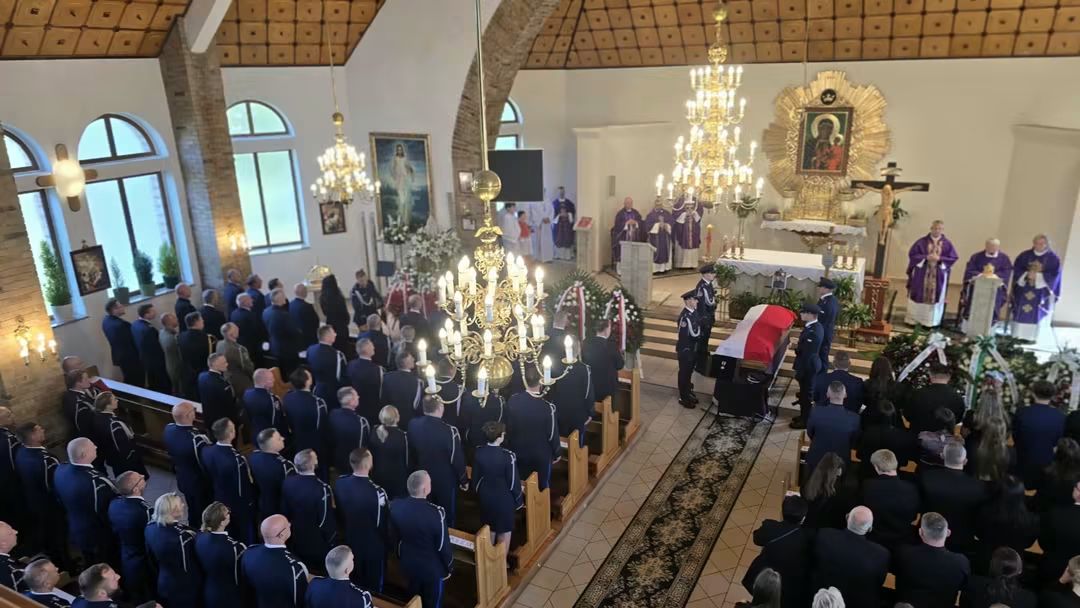
How to summarize the issue and not to torment P.T. readers with long lines of obviousness? So let us go consecutive to part 4 of the 5 parts of this "Letter of the Polish Episcopal Conference on the Holy Family" read throughout Poland at Mass on 28 December (in Mass the day of the Holy Youths-Rzezi Niewiniątek, sic!) 2025.
We decide to quote part IV of this curiosal text (the remainder of the Episcopal Letter is similar), stopping in our further comment at certain places, in the first numbers previously marked by us. We draw the attention of P.T. Readers to taken not from the eternal Holy Theology, but from today's psycho-modern naming-terminology utilized in the "List", not in the former, unfortunately. As we read:
‘IV Persons surviving in irregular relationships (1).
We would like to address a fewer more words to those who live in various types of (2) irregular situations (1). We are convinced that many specified relationships (3) permeate actual (4) care, deep bond and responsibility. frequently besides longing (5) – silent, deep, sometimes unspoken. The longing (5) for blessing (6). Man is so created that erstwhile he loves, he wants this love to be full, or truly (7) blessed (6). Not only by men (8), but besides by God.
In the Sacrament of matrimony (9), something happens that no notary, no signature, no human declaration can give. erstwhile they accept this Sacrament with faith, they may experience that God has joined them together and “there are no more 2 but 1 body” (Mt 19:6). Therefore, the Sacrament of matrimony (9) is not a "religious duty" (11). This is the privilege (12), to which our Heavenly Father invites (13). For God dreams of a household that is home to love (14).
We would like to invitation you (13) to look at the teaching of the Church on the Sacrament of matrimony (9) as an invitation (13) – a step further and deeper (15). possibly present there are obstacles (16) that do not let (17) You will receive this Sacrament (9). However, we believe that God does not delete you (18) and invites (13) to the next step of religion (19). For individual it may be a 20) request of Jesus for light and guidance; for individual to scope for God’s Word; for individual to engage in local pastoral ministry; for individual to confess after years, or to talk to a pastoral minister and to search God’s solutions.
Those who can (17) regulate their situation present (1) want to invitation (13) to dare (21) to this step (19). With all his beautiful consequences, and especially the peculiar presence of God in matrimony (9).
Those for whom it is simply a painful subject (22) due to the fact that they have a large longing (5) for the Sacraments (9), we want to guarantee that you are inactive part of God's family—the Church. You are not faithful to the second category (23). For each of us, as a disciple of Jesus (24), was redeemed at the price of His Blood (cf. 1P1, 19). Each of us by his death became a kid of God (cf. 1J, 3.1). Each of us, through His resurrection, can cry out to God “Abba, Father” (cf. Rom 8:15). Each of us can return to the Father today, who has a good plan for our lives, no substance how complicated it would be.”
Really, this is no longer Catholic teaching. For our childhood and youth, in the 20th century, and of course through the centuries preceding, teaching was simple, just Catholic:
This is the relation between a man and a female after the conclusion of the Holy Sacrament of matrimony (above paragraphs 6 and 9) is acceptable to God and fruitful in children raised in Catholic – which is barely mentioned in the Episcopal Letter mentioned above – while non-sacrifical intercourse is simply a sin. That's it. But this is what is not written in the Episcopal List.
Let us add that this sin, mostly called adultery, is divided into contritions erstwhile both (or how many of them are there!) mates are not married—especially young and very young people—and adultery associated with marital betrayal (!) erstwhile at least 1 of the sinners is married, but with a 3rd person. Also, this cardinal issue is not addressed in the Episcopal List. And all this together is contained in a very spacious and worthy discussion of the category of sin of impurity, the other virtue of purity.
In the small Catechism we read above all the Commandments of God: “6. Do not commit adultery,” “9. Do not desire your neighbor’s wife (husband).” It is besides appropriate to callback how present the silent catechism set of "nine sins of others," or own sinful reactions to another sins. So sin is, among another things, "3. let another sins," "5. Praise others," "6. Silence seeing another sins," "7. Being able not to prevent another sins."
And in general, this should be: “1. Sinners to reprove”, “2. incapable to instruct”, “3. Doubtful to advise well”—these are besides calls with the small Catechism of the set “Seven acts of mercy toward the soul”.
All this in the aforementioned Episcopal Letter read after churches in Poland on Sunday in Octava of Christmas on 28 December 2025 – not words.
So all of today’s “toleranceism”, “probability”, “pluralism”, “dialogicism”, “ecumenism”, etc., are helplessly reflected from the walls of the fortress of small Catechism. In specified a confrontation, this 1 has fallen since the 1960s. The 20th century spread of manners at all costs "not interfering in another people's affairs."
Already the 3rd generation of “Catholic” parents (and grandparents-grandmothers) seeing the mistakes of their children (and grandchildren) present – here: fornication, adultery, fornication, indecentness, promiscuity, incontinence, etc. – self-justifies itself with the cry: “These are adults, so responsible, so let them do what they want. In another people's lives you should not interfere at all" (there comes this media: "Do whatever you want!).
However, mentioned above in brief (Little Catechism) The Holy Catholic Doctrine, however, preaches the opposite, but in the name of simple consideration it does not call for nosy and pushy. Atolls, regardless of the age of interlocutors, should be admonished for good. As a last resort, but in the name of fact and Christian Concern, even a young old man can be admonished, if necessary: everyone.
In the pre-revolutionary Church, these and another simple principles of our Holy Catholic religion were known widely, and to large people and to these small ones. Without hesitation, she recited it from memory following the small Catechism of the kid at the latest in the age appropriate for accepting the Sacrament of Confirmation, but the younger 1 besides already.
At this point we can conclude this statement, due to the fact that P.T. Readers have already found that at least this quoted passage of the Episcopal Letter read after the churches in Poland on Sunday 28 December 2025 as live with the cited catechism content does not agree (the remainder of the Episcopal List mostly do not agree). But let's get a small bit tired.
In particular, this passage of the 4th "Letter" entitled "People surviving in irregular relationships" (with us sign: 1) appears to us as inspired not by the Holy Theology at all, but – for an apology – belonging to the area of the "popular cinema" Anglo-Stantan post-Protestan "romantic comedy" (as it is called), many "telenovela", but no longer "family cinema", as authors of the " Episcopal List" about children-seeds of considerations do not.
Speaking of cinema, let's callback the scene from the celebrated biographical-memory movie about Blessed Jerzy Popieluszka. Here Fr Jerzy confesses in the area of Huta Warszawa workers before giving them Mass there. And here is simply a peasant-penitent telling the Confessor about his – how the authors and signatories of the Episcopal List – "an irregular relationship" (1) euphemistly admit that his children are unbaptized, etc.
The confessor with a calm voice refuses to absolve him (so we remembered this scene) and does what he is doing with the various words and half-words taken from today's (2025/2026) psycho-modern WELCOME the authors and signatories of the aforementioned Episcopal Letter, that is, he urges the penitent to give to the Holy Baptism his own children as shortly as possible to rise them in Catholic and with the parent of these children to conclude the Holy Sacrament of Marriage. Simple? That's it. That's it.
The boy bounces distant like I've been stung, but after a while he calms down, turns around and says to this Priest Confessor: “I am very sorry. I know that the priest must speak... in the priestly language” (sic! we quote from memory).
Exactly! That's it. That's it. To the authors and signatories of the Episcopal List, not only that the movie scene mentioned is above all fundamental (!) and eternal (!) problem it depicts are apparently... foreign, unknown. I can't believe it, but... we read their text black and white. All faithful including a tiny school children (!) had to perceive to him after the churches on the last Sunday of the year 2025. What a scandal! Aggravation – this expression, alongside many others, for decades has been persistently avoided by nominally Catholic preachers and catechists.
The full contents of the Shepherd’s Letter are available Here..
We besides recommend: California endures restrictions on the sexualisation of children in school libraries